x
What Is The Library Folder On A Mac
- What Is The Library Folder On A Mac Computer
- What Is In The Library Folder On A Mac
- What Is The Library Folder On A Mac Laptop
The Library folder, at the root level of your Mac OS X Lion hard drive, is like a public library; it stores items available to everyone who logs into an account on this Mac. You can find three Library folders on your hard drive: the one at the root level of your OS X disk, a second inside the root-level System folder, and a third in your Home folder.
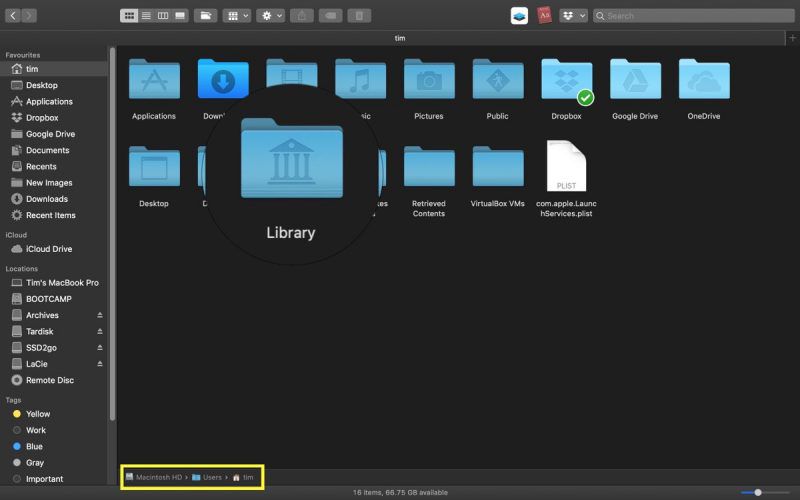
In earlier versions of Mac OS X, you would have seen a folder named Library between the Downloads and Movies folders in your Home folder. But that was then, and this is now. In Mac OS X Lion, the Home Library folder is hidden from view to protect you from yourself.
Leave the /System/Libraryfolder alone. Don’t move, remove, or rename it, or do anything within it. It’s the nerve center of your Mac. In other words, you should never have to touch this third Library folder.
Sep 27, 2016 A lot of Mac tutorials mention the Library folder, which is where your macOS applications store things like settings and caches. Some settings can only be changed by editing files in the Library. But the Library is hidden by default. May 30, 2019 Show Library folder on mac with Terminal in OS X 10.11 El Capitan and earlier versions Launch Terminal from Spotlight or Launchpad. Type in the window the next command. The user's Library folder, which is different than the root Library folder at the top-level of the hard drive, contains hundreds files that store important preferences and settings for many of the applications on your Mac. It's good to learn how to access this folder, even if you don't need to open it right now.
You find a bunch of folders inside the Library folder at root level (the public Library folder). Most of them contain files that you never need to open, move, or delete.
By and large, the public Library subfolder that gets the most use is the Fonts folder, which houses many of the fonts installed on the Mac. For the most part, fonts can be made available in one of two ways:
To everyone who uses the Mac: If that’s the case, they’re stored in the Fonts folder.
To a single user: In this case, you place the fonts in the user’s Library folder (the one in the user’s Home folder).
Some other public Library subfolders that you might use or add to are the iMovie, iTunes, iPhoto, and iDVD folders (where you put plug-ins for those programs); the Scripts folder (which houses AppleScripts accessible to all users); and the Desktop Pictures folder (where you can place pictures to be used as Desktop backgrounds).
Leave the “public” Library folder pretty much alone unless you’re using the Fonts folder or know what you’re adding to one of the other folders. Don’t remove, rename, or move any files or folders. Mac OS X uses these items and is very picky about where they’re kept and how they’re named.
If your Mac is set up for multiple users, only users with administrator (admin) privileges can put stuff in the public (root-level) Library folder.
Your Photos library holds all your photos, albums, slideshows, and print projects. If your library is large, and you want to free up storage space on your Mac, turn on iCloud Photo Library and use Optimize Mac Storage, or move your library to an external drive.
Before you start, be sure to back up your library.

Prepare your drive
You can store your library on an external storage device, such as a USB or Thunderbolt drive formatted as APFS or Mac OS Extended (Journaled).1 Find out how to check the format of your external storage device.
Maybe it’s become corrupted and Photos won’t open, or maybe you just want to start fresh and archive your old one.Regardless, to create a new System Photo Library, first open the location where your current system library is and drag it to a backup spot if you want to keep it (recommended). Click “Open Other” to either find an existing library or create a new one. Mac icloud account. Drag it to the Trash if you don’t.Next, open Photos, which will spur the following prompt.
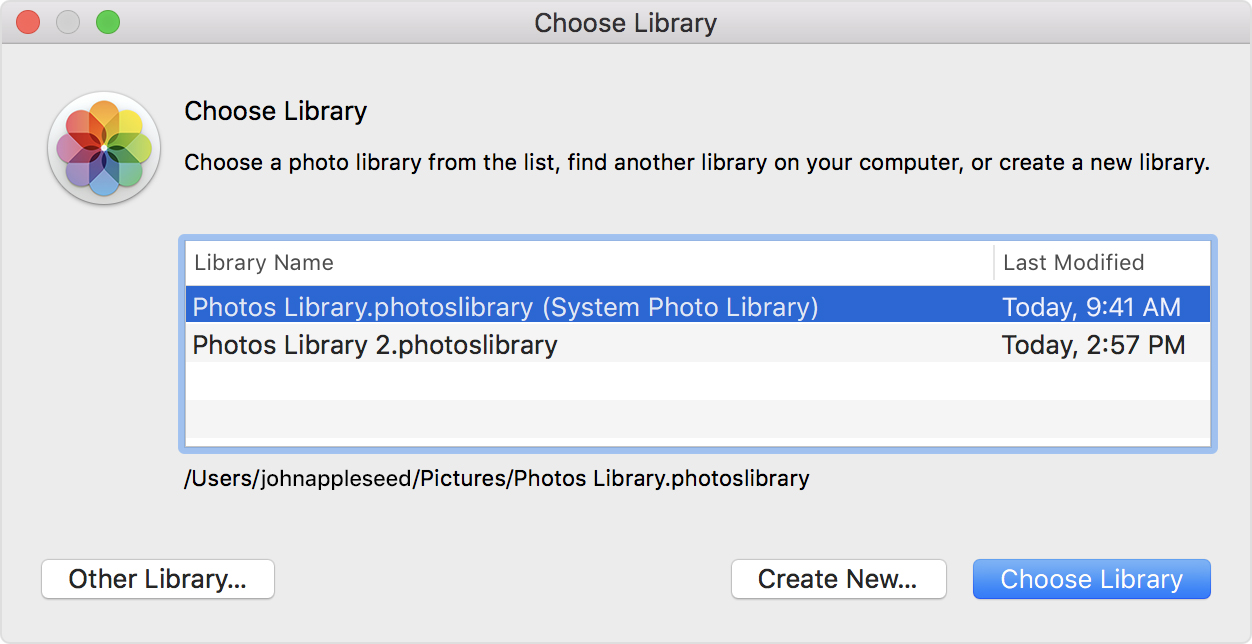 Where are the photos I imported into Photos on my Mac? By default, the photos and videos you import into Photos are stored in the Photos library in the Pictures folder on your Mac. When you first use Photos, you create a new library or select the library that you want to use. This library automatically becomes your System Photo Library. Mar 18, 2020 Move your Photos library to save space on your Mac - Move your Photos library to an external storage device Quit Photos. In the Finder, go to the external drive where you want to store your library. In another Finder window, find your library. Drag your library to its new location on the external. Store imported files outside the Photos library. In the Photos app on your Mac, choose Photos Preferences, then click General. Deselect the “Copy items to the Photos library” checkbox. Now, when you import photos or video, Photos leaves the files in their original.
To prevent data loss, Apple doesn't recommend storing photo libraries on external storage devices like SD cards and USB flash drives, or drives that are shared on a network.
Move your Photos library to an external storage device
What Is The Library Folder On A Mac Computer
- Quit Photos.
- In the Finder, go to the external drive where you want to store your library.
- In another Finder window, find your library. The default location is Users > [username] > Pictures, and it's named Photos Library.
- Drag your library to its new location on the external drive. If you see an error, select your external drive's icon in the Finder, then choose File > Get Info. If the information under Sharing & Permissions isn't visible, click , then make sure the 'Ignore ownership on this volume' checkbox is selected. If it's not selected, click to unlock it, enter an administrator name and password, then select the checkbox.2
- After the move is finished, double-click Photos Library in its new location to open it.
- If you use iCloud Photo Library, designate this library as the System Photo Library.
Delete original library to save space
After you open your library from its new location and make sure that it works as expected, you can delete the library from its original location.
In a Finder window, go back to your Pictures folder (or whichever folder you copied your library from) and move Photos Library to the trash. Then choose Finder > Empty Trash to delete the library and reclaim disk space.
Open another Photos library
If you have multiple libraries, here's how to open a different one:
- Quit Photos.
- Press and hold the Option key while you open Photos.
- Select the library that you want to open, then click Choose Library.
Photos uses this library until you open a different one.
Learn more
What Is In The Library Folder On A Mac
If you have a permissions issue with your library, you might be able to resolve the issue by using the Photos library repair tool.
1. You can't move your library to a disk that's used for Time Machine backups.
What Is The Library Folder On A Mac Laptop
2. If the volume isn't formatted APFS or Mac OS Extended (Journaled), or has been used for Time Machine backups but hasn't been erased, this checkbox will either not be present, or won't be selectable after unlocking. Erase and reformat the drive for this option to be available.