x
Show User Library Mac High Sierra
Of the many files and folders that make up macOS Sierra, there’s probably none so important to maintaining the “personality” of your Mac than the ~/Library folder. Inside this folder are many subfolders that contain preference lists (“plists”), database files storing a variety of important information, and many other files that maintain the state of macOS and of the individual apps that run on a Mac. Thanks to the importance of this folder, it’s normally hidden from view. Today we’ll show you a few ways to view the ~/Library folder.
How To: Show the User Library Folder in macOS Sierra Chris Hauk - Dec 30, 2016 While many Mac users may never need to access their User Library folder while running macOS Sierra — some advanced users, may need to get in there and access support data and such when troubleshooting. 2020-3-31 How to Unhide and Make Library Folder Visible in macOS Sierra. Clicking on the folder will take you to the current user account’s Library folder. What we’re interested in is the option that says “Show Library Folder.” You need to checkmark this option and it will make the Library folder to appear in the regular menu of the. 2017-12-6 on both the employee’s desktop Mac Computer and laptop Mac Computer, or multiple students may serially use the Apple Software on a single Mac Computer located at a resource center or library; and (iii) to install, use and run up to two (2) additional copies or instances of the Apple Software. 2020-4-6 The User Library folder is hidden by default in MacOS Catalina, MacOS Mojave, macOS High Sierra, and macOS Sierra, but some advanced users may wish to show and access the /Library/ folder, which contains preference files, caches, and application support data.
Apart from its security and optimized storage features, mac Sierra – the latest macOS version, is not different from these mac versions. What You’ll Get from This User Library Folder? Well, it’s the place where Mac power users cannot skip or avoid. It’ll contain preferences, files, cache, application support data and much more. Dec 12, 2016 How to Show /Library Folder in MacOS Mojave, High Sierra, Sierra. If you access user /Library often you might want to just enable it permanently as a visible folder in the user home directory. This is a simple settings change that will cause MacOS Finder to always show the Library folder in the user home.
In this way, you can also preserve the library on your iPhone, iPod Touch or iPad. The transfer speed also depends on the size of your iTunes library items. Moreover, it will also save you a lot of time as you will not need to transfer the data from one computer to hard drive and then to the other computer. That completes our third method to transfer the iTunes library from PC to Mac successfully.Conclusion:All methods have their own pros and cons, if you don’t want to use the same iTunes account on both computers, the best way is to transfer the iTunes library from PC to Mac using iMusic. My itunes.
Warning: Don’t play with the ~/Library folder if you don’t need to!
Before we go any further, it’s time for a warning. Don’t throw away or change anything in the ~/Library folder unless you know what you’re doing. Deleting individual files or folders found within ~/Library can cause individual applications or the operating system to malfunction.
When would you want to poke around in ~/Library? Perhaps you’re gaining knowledge about macOS as a developer and want to know how the operating system stores information. Maybe you want to clean out the remnants of an app that you haven’t had on your Mac for several years. In any case, it’s best to remember what your parents told you when you were a kid and were in a place filled with expensive and breakable things — “Look, but don’t touch!”
Method One: Our Friend, the Option Key
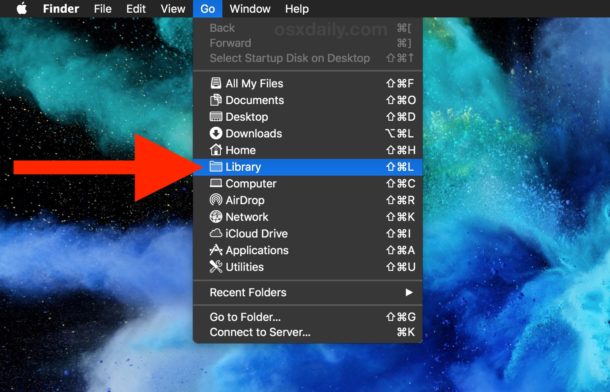
The first and easiest way is to use a trick that gives many of the items in the macOS menu bar “super powers” — hold down the Option key while clicking on a menu. In this case, Option-clicking the Go menu in the Finder adds a new menu item — Library — that opens the ~/Library folder (see image below):
As you can see from the image above, holding down the Option key while clicking on the Go menu in the Finder adds one item as seen on the right — the Library folder. Select that menu item and a window similar to the one seen below opens on the Mac screen:
Of these folders, Application Support is quite critical as it holds information for the current user’s apps. You’ll see many “.plist” files; these are XML (Extensible Markup Language) files that can be viewed on the Mac by simply highlighting the file and pressing the space bar to bring up a Quick Look. There are also a number of log files (text-based), temporary files, app plugins, and database files (.db or .sqlite) that are critical to storing settings and data in your favorite apps.
Method Two: Command-Shift-Period
The second method works from any open Finder window, and it uses the keyboard shortcut Command-Shift-. (that dot indicates the period key). This is a fun command, as it makes any hidden files or folders visible in the Finder. On the left in the image below you see my Home folder. Pressing Command-Shift-. makes hidden folders and files appear as shaded icons, shown on the right:
Pressing Command-Shift-Period makes hidden files and folders visible (right image)
Mar 07, 2016 How to set Photos library as a screen saver on your Mac. 1) Launch System Preferences on your Mac. 2) Click the Desktop & Screen Saver preference pane. 3) Click the Screen Saver tab. 4) Select a desired screen saver in the lefthand column. RELATED: How to set photo albums as Mac desktop wallpapers 5) In the righthand column, click the pop-up menu next to Source and select a recent photo. Oct 16, 2019 Here's what you need to know about bringing your older pictures and libraries to Photos for Mac. Open Photos from your Dock or Applications folder. Click on the File menu. Select Import (or type command-Shift-I). Find and select the image(s) you're looking to import. Click Review for Import. This is one thing I don't quite get it for the Mac: why is it so hard to start a slideshow? The most often way is, I have several photos on the Desktop or in Downloads, and I double click to see the. How to start a slideshow on the Mac quickly and easily? Ask Question Asked 8 years. Then press 'play' to start the slideshow. For OS X 10.9. You can export slideshows to share with others. When you export a slideshow, Photos creates a movie file with the video format that you select. In the Photos app on your Mac, click a slideshow under Projects in the sidebar. Click Export in the toolbar, or choose File Export Export Slideshow. Mar 16, 2018 Now import your favorite pictures from your Mac. Slideshow Maker for Mac utilizes a Media Browser for you to effectively import pictures, videos and audios to your project. Tap the Media Browser icon to turn it on or off. You can drag photos from iPhoto library or other folders in your Mac hard drive to the timeline. Play slideshow photos mac import library.
See that Library folder in the center of the list on the right? Even though it is shaded, it can be double-clicked to open and view everything that’s in the folder. What’s more, some of the files that are not visible in the ~/Library folder when using Method One appear when using Method 2.
One other thing to note: Command-Shift-. makes these files and folders visible until the next time you use the command or reboot the Mac. If you’re poking around in the ~/Library folder on a Mac that other people may use without having their own logins, be sure to press Command-Shift-. one more time to set things back to hidden once you’re done. Note that Command-Shift-. also makes Library visible in the Finder Go menu without having to press the Option key…
Just remember, anything you change or delete in the ~/Library folder can affect how your Mac or individual applications work, so use these methods to just view hidden files or folders. Don’t delete the files or folders in ~/Library unless you know what you’re doing.
While many Mac users may never need to access their User Library folder while running macOS Sierra — some advanced users, may need to get in there and access support data and such when troubleshooting. The folder is hidden by default in macOS Sierra, but it only take a few moments to access it, or make it so that the folder is always visible.
Before we begin, we want to say that it’s usually a good idea to leave things in the users ~/Library folder alone, unless directed to by support personnel. The folder contains caches, application support data, and preference files, and if you screw around in there too much, you could really screw things up. We DO NOT recommend it. Now that our butts are covered, here’s how to find and display your User Library folder.
Opening the User Library Folder in macOS Sierra
If you just need to access the user ~/Library folder on occasion, you can get into it by using the Finder “Go” menu.
- From the Finder in macOS, (Click anywhere on the Desktop where there isn’t already an app window, and you should see “Finder” appear in the upper left hand corner of your display, up near the Apple icon), click the “Go” menu item, and then hold down the SHIFT key on your Mac’s keyboard.
- Click on “Library” in the drop-down list. (If you release the SHIFT key, the “Library” option will disappear from the menu. Now you see it, now you don’t.)
If you’re not much of a mouser, you can just hit the key combo of Command + Shift + L, and a Finder window will appear showing the ~/Library directory of the active user account.
Always Show the User Library Folder in macOS Sierra
If you are an advanced user, you might want to always display the user ~/Library folder in your user Home directory. It just takes a few clicks to enable this option.
- In Finder, go to the Users’ home folder
- Click the “View” menu and then click “View Options”
- Click the “Show Library Folder” option in the Settings options for the User home folder, as shown below.
Following the above steps will change the settings for only the current user. Any other users will also have to follow the above steps while logged into the machine.
Mac El Capitan
These steps also work with Mac OS X El Capitan and Yosemite. In earlier versions of OS X, a command line entry was required to perform the same magic.
Macos 10.13 High Sierra
(Thanks to OS X Daily)