x
Mac Clear Out Library Caches
- Mac Clear Out Library Caches On Mac
- Mac Clear Cache Files
- Mac Clear Library Caches
- What Are Caches On Mac
Your Mac takes care of routine maintenance behind the scenes eventually, but that doesn’t mean you can’t keep things tidy yourself in the meantime. One easy way to keep your Mac running its best is to occasionally clean the cache.
How to clear cache files step-by-step?
There are three types of caches you can clean on your Mac:
- User (or App) cache. These cache files created by all the apps that you use on Mac. It includes apps that came with your macOS (like Mail) as well as 3rd-party apps (like Sketch). Every applications creates a lots of cache - it wouldn’t be surprising to clear up gigabytes of space when cleaning app caches.
- System cache. These cache data created by the built-in macOS system services that run your Mac.
- Browser cache. All browsers store your browsing history and cache data from websites you visit. You know how you shop for something online and then for weeks you’re seeing it everywhere? That’s because your browser caches hundreds of files that make up the websites you visit. Caches also include cookies and trackers that save information about your browsing history and report the data back to the site. This works out in your favor when you return to a site without having to log in again, but it can also leave you feeling like your computer is spying on you.
How To Clear Cache on Mac? Deleting the Web Cache (In Safari): If you’re a Mac user, it is entirely possible that Safari is your default browser. Surfing the Internet of course ends up giving a lot of cache files, which need or should I say MUST be deleted before it clogs all your space. Enter your Mac's password in the action-confirmation pop-up to clear your computer's cache. Related coverage from How To Do Everything: Tech: How to clear the cache on your iPhone and make it run. Feb 14, 2013 How to clear your cache on a Mac - There are a couple of cache folders you need to clear on a mac. See how to do it and delete your trash securely. /Library/Caches Claude Pelanne.
Old cache files do nothing but cluttering your system and slowing down your Mac through all the wasted space it is taking up. Here's a guide to cleaning all these caches, at the end of which your Mac will be lighter and leaner.
The guide to clean all caches on your Mac
Besides browser and website information, your Mac keeps several caches of its own for different reasons. The good news is you can clean them up manually, or you can clean them with a special app which can clear the browser cache in Safari, Chrome, and Firefox, as well as your system cache, email cache, user cache files, and even your DNS cache files.
Mac Clear Out Library Caches On Mac
Clear your cache in one click
Install the best utilities for clearing your cash — enjoy a clean system and a fresh browsing experience on Mac.
Delete user caches on a Mac
User cache makes up the majority of junk data on macOS. Your applications accumulate user's cache data on a hard disk the longer they are in use. Some apps and utilities can build up cache sizes that reach into gigabytes. This is often just a waste of space, particularly with apps you don’t use every day. By clearing your user apps cache files, you’ll be amazed at how much hard disk space you can reclaim.
Note: Manually clearing cache files on a Mac is something that anyone can do. It takes some time and patience, but if you follow our instructions, you can get the job done all by yourself. Please follow the instructions closely.
Clean up cache files manually
To find and clear your user cache manually, do the following:
- In your Mac’s user folder, there’s a hidden Library folder, which itself contains a folder of caches left by the applications you’ve installed on your Mac.
- Strongly recommend that you remove the insides of ~/Library/Caches and /Library/Caches folders, but not the folders themselves.
- Want to make sure your junk user cache data is gone forever? - Empty out your Trash.
If you are unsure and want a safer option, go ahead and learn on how to use CleanMyMac to handle caches properly. It will find up to 5x more junk cache data to remove from all over your system.
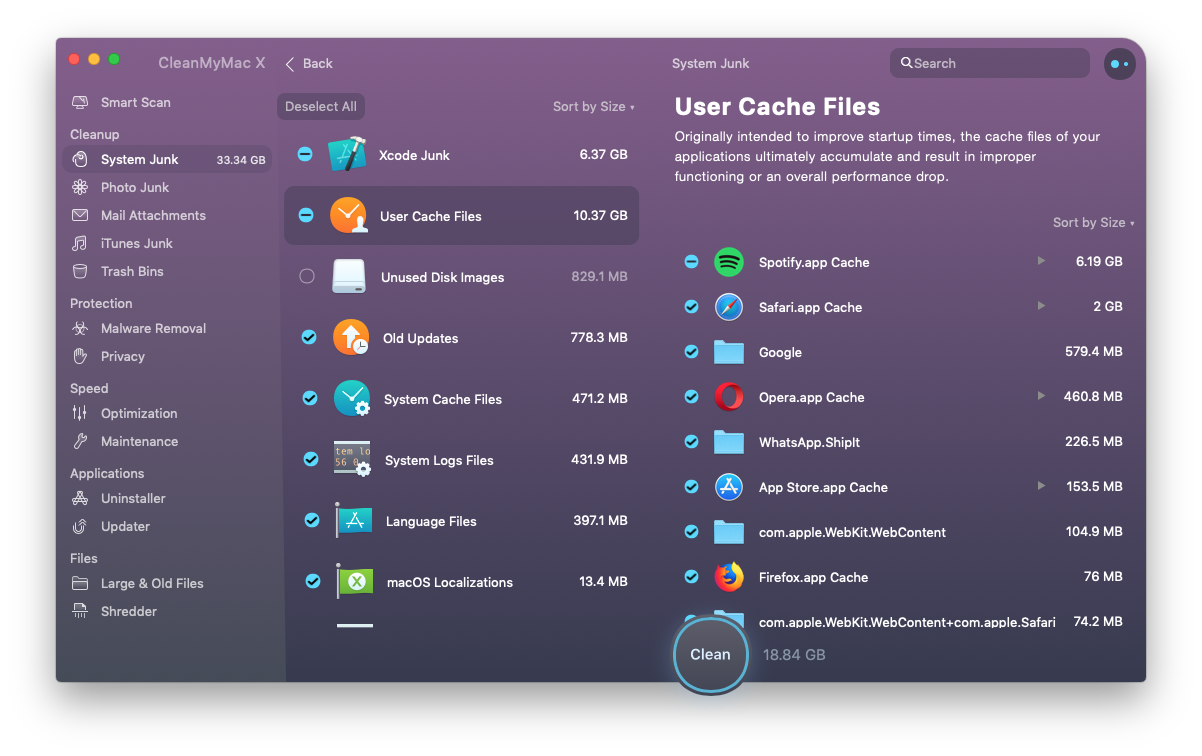
Get rid of cache files with CleanMyMac
- Launch CleanMyMac app.
- Select System Junk in the left sidebar.
- Hit Scan at the bottom of app's window.
- Then click Clean.
And you're done! If you’d like to remove only cache files and nothing else, click on Review Details before clicking Clean. Deselect everything but System Cache Files and User Cache Files, then click Clean.
Delete system caches on Mac
System cache files are generated by OS X and, unlike application cache, have nothing to do with the user. The hidden system caches are mainly created by the apps that run on your Mac. The clearing of system cache is not recommended in manual mode, unless you are very careful or trying to fix a problem. System cache files do not generally take up much space, which is another reason why a clean out isn’t as necessary as with user cache.
Get Setapp, all problem-solvers for free
Install Setapp in one click — get your hands on a full pack of Mac applications that will keep your Mac in a good shape, always.
Clean up system cache data manually
You can find and delete system cache in the same way as user cache, by
- Going to ~/Library/Caches and hit Enter to removing the insides of the folders with the app name.
- System cache folders are named com.apple and should be backed up for safety.
- Go into the com.apple folders and delete the files inside of them. Only the files, not the folders!
- Right click on the Trash icon and “Empty Trash”.
That’s it, now, just like with your user cache, your system cache is also clear.
Be careful: not all app cache files can be safely deleted. Some app developers keep important information on cache folders. The great idea to backing up a folder before you erase all files inside. If everything works fine, you can delete this backup.
One-button solution to cleanup macOS caches
CleanMyMac is such a great tool because it lets you perform the exact maintenance you want, or run a Smart Cleanup scan with a single click and have the software make recommendations.
Clean up browser caches
We love our browsers but we don’t love it when they start to use up hard disk space with cache files. Whether you’re wanting to free up space, get your browser performing better or trying to remove your history for the sake of privacy, removing your Mac browser cache will help.
Flush DNS caches
Your Mac’s DNS cache is a list of all the DNS queries that were resolved for every site. When you type in 'setapp.com,' the DNS server resolves that to a numerical IP address. But if you notice a site not loading, or your browser acting up or working too slowly, resetting the DNS cache might be the cure.
To flush DNS cache manually
- Open Terminal (⇧ Shift+⌘+U, and double-click on Terminal)
- Type this into Terminal: sudo dscacheutil -flushcache;sudo killall -HUP mDNSResponder;say cache flushed
- Press Enter to run and fill your admin password to execute the command.
To clean your Mac’s DNS cache in one click
- Open CleanMyMac and select Maintenance in the left sidebar
- Check the box for Flush DNS Cache
- Click the Run button at the bottom of the window
Your browser cache is essentially saved bits of the websites you’ve visited recently. That way, if you go back, your computer can re-use locally cached elements that haven’t changed, which speeds up load times versus reloading everything fresh from the remote server. Your cache will overwrite itself eventually, but you can clear your cache, history, and cookies anytime you want to gain a little bit of extra security and speed up your Mac.
Clear Safari caches step-by-step
To delete Safari's websites' caches and cookies via browser preferences:
- Click Safari in the top menu click Preferences.
- In the window that appears, click the Advanced tab, and enable Show Develop menu.
- In menu bar go to Develop and choose Empty Caches.
Check and delete Safari browser cache with Terminal:
- Press Command + Shift + G to open up the Terminal
- With these simple commands you can delete Safari's cache file. But first, check its size using the disk usage (du) command:
du -h /Users/$HOME/Library/Caches/com.apple.Safari/Cache.db
Note: replace '$HOME' with the name of your home folder- To delete Safari's cache file type:
rm /Users/$HOME/Library/Caches/com.apple.Safari/Cache.db
Note: when you use the remove (rm)command files are essentially unrecoverable. - A more prudent approach is to use the move (mv) command:
mv /Users/$HOME/Library/Caches/com.apple.Safari/Cache.db ~/.Trash/
This will move the file to your user's ($HOME) trash. From there it is still recoverable until you empty the trash.
Safari will create a new Cache.db file automatically when you open a new webpage. - Open a new webpage or restart Safari and recheck disk usage:
du -h /Users/$HOME/Library/Caches/com.apple.Safari/Cache.db
- To delete Safari's cache file type:
That's all.
Chrome clearing cache tutorial
The simplest way to clear Chrome browser cache manually is:
- In the top right corner of Google Chrome browser click the 3-dot icon to choose Settings.
- At the bottom of the menu, choose Advanced (or use Cmd+Shift+Delete keyboard shortcut)
- Click Clear browsing data and deselect all, but Cached images and files. Choose time range and hit Clear data button.
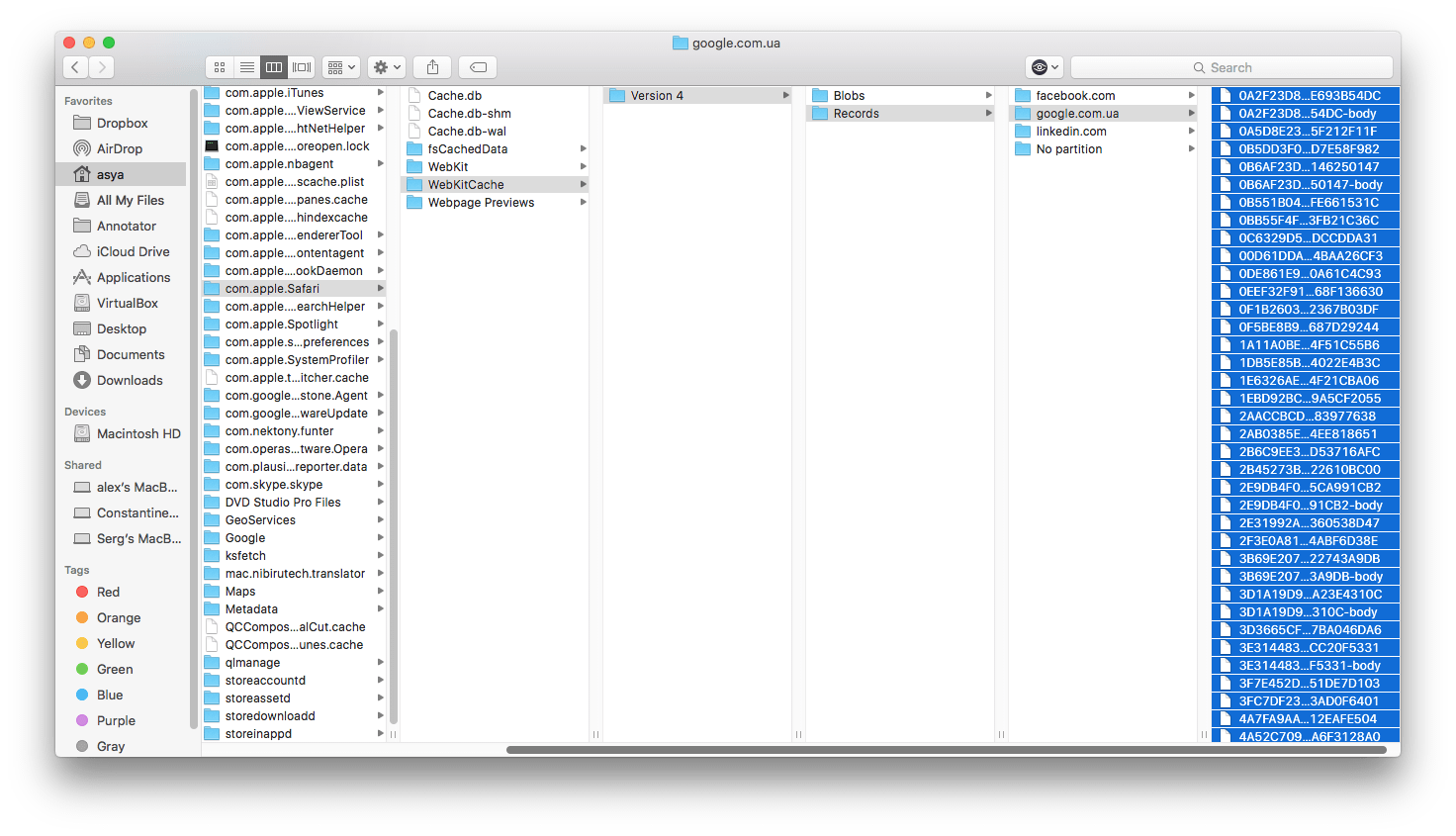
One more way to delete Chrome browser cache is to clear some folders where these data located.
Installing Watchtower Library on a Mac with macOS Catalina Over the years there have been several tools and instructions on how to get the Watchtower Library to run on a Mac. Since it is a Windows application it will not run natively without using some sort of Windows emulator that enables a Windows program to run on the Mac. Installing pbc library on mac os. The PBC library is a free portable C library allowing the rapid prototyping of pairing-based cryptosystems. It provides an abstract interface to a cyclic group with a bilinear pairing, insulating the programmer from mathematical details. Knowledge of elliptic curves is optional. Installing PBC. The PBC library needs the GMP library. This build system has been tested and works on Linux and Mac OS X with a fink installation. Installing PBC. Table of Contents. Simple Makefile Quick start Basics. The PBC library needs the GMP library. This build system has been tested and works on Linux and Mac OS X with a fink installation. $./configure $ make $ make install.
- To find Chrome cache files, open Finder and click to Go to the folder.
- To go to the folder where Chrome' primary cache locates type: ~/Library/Caches/Google/Chrome/
- To go to the folder with the additional bulk of cached data type:~/Library/Application Support/Google/Chrome/Default/Application Cache/
- Select files within these folders and delete them.
How to delete cache in Firefox manually
- Click the hamburger icon in the top right corner and choose Preferences.
- Choose Privacy & Security on the left sidebar.
- Scroll to the section Cookies and Site Data and click to Clear Data.. tab
- Now, check Cached Web Content and click Clear button to delete Firefox cache.
- Exit/quit all browser windows and re-open the browser.
How to clean all browsers cache data at once
- Open CleanMyMac and select Privacy in the left sidebar
- Click Scan at the bottom of app's window
- Then Select Items to advance to the next page. The list is broken down by app: you can check each browser to remove all data, such as cookies, browsing history, downloads history, HTML5 local storage, saved passwords, and even close the tabs from your last session. Or you can uncheck any of that you want to keep
- Click the Remove button at the bottom of the window when you’re ready to delete everything that’s checked
Shape up your Mac even more with other apps in Setapp
CleanMyMac isn’t the only app in the Setapp collection that helps you take good care of your Mac. Setapp gives you access to all of its apps at once, so you can try to get your Mac in even better condition with no downside. Here are some examples.
Declutter automatically sorts files you leave on your desktop, so they’re not cluttering up your view but are still easy to find.
Disk Drill can perform data recovery tasks, like restoring deleted files that haven’t been written over yet, or grabbing anything usable off a corrupted flash drive.
Gemini can find duplicate files. For example, photos and videos you downloaded from your iPhone as well as emailed yourself. Or PDFs you downloaded and filed away once, only to download again later when you forgot you already had a copy.
iStat Menus monitors your Mac’s vital signs in real time, so when things slow down you can see which app is hogging all your memory.
Get Backup Pro makes it easy to make bootable backups of your system, making emergencies not so scary anymore.
No one likes a slow Mac, and it’s a good idea to clean it up every so often. Cache files are the most common and probably the least understood offender that Setapp can help you to keep under control.
So you can do everything else in a blink of an eye. With Setapp, you have full access to the best solutions for performing routine Mac maintenance whenever you like.
You’ve no doubt heard the term cache and temp files, at least as it relates to your Mac. There are numerous times when removing a cache or temp file may be part of a troubleshooting tip to return an app or the system to a more robust condition. It’s also common to hear about removing these files to free up space on a Mac’s startup drive.
But before we head down the road to clearing out cache and temp files, let’s take a moment to find out what functions they serve, and whether it’s really a good idea to remove them willy-nilly.
(Third-party utilities, such as TinkerTool System, can help you remove troublesome cache files.)
What Are Cache Files and Temp Files?
Cache and temp files serve a similar function; they provide a place to temporarily store data in files on your Mac.
Cache files are accessed and updated frequently, and they can remain after the app or system function that created them has closed or exited. They can also remain through shutdown or restart cycles.
Temp files are created by an app or system process to temporarily store data that is later used by the process that created the file. Unlike cache files, temp files are usually removed by the process that created them, usually when the process exits, or during a shutdown or restart cycle.
Examples of cache files include browser caches that save the information from a webpage. Photos app on mac says closing library. When you return to the same page, the browser can load the page data from the cache file, provided the page data hasn’t changed. This saves you the time it would take to access the web server and download the entire page again.
Another type of cache you use everyday on your Mac is the DNS cache. Like the browser cache, the DNS cache can let your Mac grab the IP address of a website it has visited recently without having to perform a DNS lookup, which can take a great deal of time.
Other caches are used by the system to store frequently used icons, images, and just about any type of information that is used over and over, where storing the data is faster than recreating the information every time.
(My system temp files are located in a folder named T, at the end of a cumbersome pathname.)
Temp files, on the other hand, are transitory; they tend to be removed once the app or process that created them is terminated. An example of a temp file is an application that has many levels of undo. In the loosest of terms, the undo temp file holds the state of the app at each point a command was issued, letting you go back in time (undo) to previous states. When you quit the app, the undo temp file is deleted since it’s no longer needed.
Temp files can also hold static items, such as an image, or data that will be used frequently by an app but doesn’t need to be saved beyond the current app cycle.
Where Are Cache Files and Temp Files Located?
The Mac has two primary types of cache files, System and User, which are located in three primary locations. The system caches are located at /Library/Cache as well as /System/Cache. The user caches are located at ~/Library/Cache. The tilde (~) in the last cache location is a shortcut for your home folder. So, if your home folder was named tnelson, as mine is, the full path would be /Users/tnelson/Library/Cache. As you can see, it’s easier to just use the shortcut than to type full pathnames.
I recommend leaving the system caches alone unless you’re having a specific problem whose troubleshooting guide suggests removing one or more of the system cache files. Otherwise, I tend to leave system cache management to the system.
Temp files, especially those used by third-party apps, can be located just about anywhere, making some app temp files difficult to track down. However, apps that follow good coding practices will make use of a few standard locations. Unfortunately, many of these standard locations are hidden from the Finder, blocking you from direct access. You can use the following Terminal tip to open a Finder window on two of the most used temp locations:
- Launch Terminal, located at /Applications/Utilities.
- Enter the following at the Terminal prompt: open $TMPDIR
- Hit Enter or Return on your keyboard.
- A Finder window will open on the current system temporary directory.
Note: The Finder window will have a different name for this directory. The $TMPDIR is a variable that holds the current temp directory pathname.
(Terminal’s “open” command can be used to view the directories being used by the system for temporary storage.)
The second common temp location can also be found using Terminal. Enter the following at the Terminal prompt:
- Open /tmp
- Hit Enter or Return on your keyboard.
- A Finder window will open on the tmp directory.
Should You Remove Cache and Temp Files?
Generally speaking, the Mac’s operating system is pretty good at managing both cache and temp files. The Mac OS includes maintenance routines that are run at specific times to clear out unneeded cache and temp files. In addition, most temp files are cleared out automatically by the app or process that created them. The Mac OS will also remove many of the temp files whenever you shut down or restart your Mac.
Even though the Mac OS tends to take care of cache and temp files, there are times when manual intervention may be appropriate. As mentioned earlier, deleting cache files is a common troubleshooting tip. In these cases, a specific cache file may have become corrupt, and as a result, contains bad or meaningless information that is causing a related app to lose its mind. Cache files can also become excessively large, leading to long load times for the app that makes use of the file, or unusually long times for executing a specific function.
(Using the Managed Storage feature of OS X Sierra, I found over 70 GB of cache files used by an app I haven’t used in quite a while.)
Mac Clear Cache Files
The other common reason to remove cache and temp files is to increase the amount of free space on a storage volume. In researching this article, I discovered that a number of cache files used by the Steam gaming platform had grown to over 70 GB on my Mac. This was a surprise, since I haven’t used Steam in over a year, and really had no use for those cache files. The Steam cache files got the heave-ho.
But before you dump your cache and temp files, remember that generally speaking, cache and temp files are designed to improve the performance of an app or service. So, unless you’re having issues, including needing more free space, or an app that’s behaving badly, it’s probably better to leave the cache and temp files alone and let your Mac manage them.
Removing Cache and Temp Files
Mac Clear Library Caches
Warning: Before you remove any cache or temp file, make sure you have a current backup of your Mac.
One method for removing these files is to simply navigate to their location and send the various cache and temp files to the trash. You can use the Finder and the tips mentioned above to locate the files. Do not, however, delete the various cache folders; just the actual cache files within the folders.
An even easier way to access and clear out the files is to use a third-party app designed to assist in managing cache and temp files.
(Cocktail provides an easy-to-use interface for deleting cache files.)
What Are Caches On Mac
A number of these apps come to mind; most are available as demos to try out:
- Cocktail: This is a general-purpose utility for repairing and optimizing your Mac. It also gives you access to many of the Mac’s hidden settings, including the ability to run the various cache maintenance scripts.
- Onyx: Provides access to hidden Mac features, system maintenance, and the ability to customize the system and some apps.
- TinkerTool System 5: Provides access to many hidden preferences and settings of the operating system. Includes the ability to restore caches if you discover that removing a cache didn’t fix an issue.
Remember that cache and temp files are there to help performance. For the most part, I don’t recommend wholesale removal of these files as any type of “maintenance” practice. Instead, selectively removing a cache or temp file as part of a troubleshooting process can be a useful task.